
Origalys
Palladium Microelectrodes – OrigaSens Series
Palladium Microelectrodes – OrigaSens Series
Description
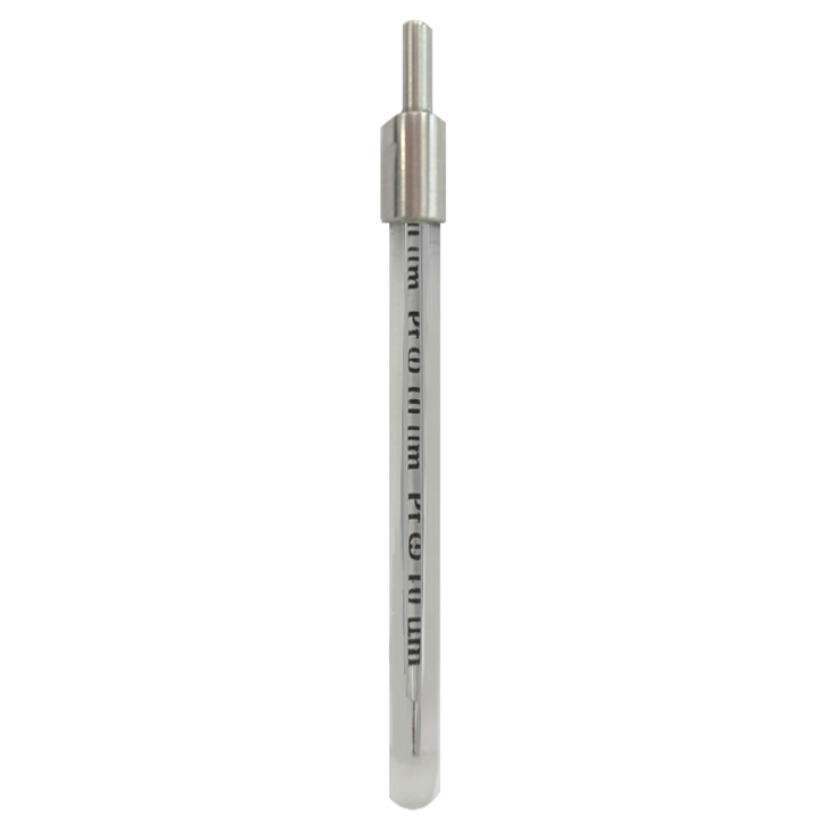
OrigaSens Palladium Microelectrodes are precision‑engineered working electrodes designed for electrochemical applications where palladium’s unique catalytic behaviour, hydrogen absorption capability, and chemical stability are essential. These microelectrodes offer excellent reproducibility and are ideal for hydrogen‑related studies, catalytic reactions, and advanced analytical research.
Key Features
- High‑purity palladium sensing surface with excellent catalytic activity
- Multiple micro‑scale internal diameters available: 25 µm, 50 µm, 100 µm, 200 µm
- Standard length: 50 mm across all models
- External diameter: 5 mm, compatible with standard electrode holders
- Encapsulated construction ensuring mechanical robustness and long service life
- Suitable for voltammetry, amperometry, impedance spectroscopy, and hydrogen‑related electrochemical studies
-
Provides stable, low‑noise microelectrode behaviour with high reproducibility
- Operating temperature range: 0–40 °C
Available Palladium Microelectrode Models
| Model | Internal Diameter | Length | External Diameter |
|---|---|---|---|
| Palladium Microelectrode – 25 µm | 25 µm | 50 mm | 5 mm |
| Palladium Microelectrode – 50 µm | 50 µm | 50 mm | 5 mm |
| Palladium Microelectrode – 100 µm | 100 µm | 50 mm | 5 mm |
| Palladium Microelectrode – 200 µm | 200 µm | 50 mm | 5 mm |
Applications
- Hydrogen absorption/desorption studies
- Catalytic electrochemical reactions
- Fuel cell and hydrogen‑storage research
- Analytical electrochemistry and trace detection
- Microfluidic and small‑volume experiments
-
Sensor development involving catalytic or hydrogen‑sensitive systems
Why Choose OrigaSens Palladium Microelectrodes?
Palladium is uniquely suited for hydrogen‑related electrochemistry thanks to its ability to absorb hydrogen and its strong catalytic properties. OrigaSens microelectrodes are manufactured with tight dimensional tolerances, ensuring reproducible performance and compatibility with a wide range of potentiostats and laboratory setups. Their robust construction and stable electrochemical behaviour make them an excellent choice for advanced research applications.
Share